

Summary
- A partial knee replacement may be enough when arthritis is limited to one part of the knee.
- Bone-on-bone arthritis does not always mean a total knee replacement is required.
- Patients with localised cartilage wear and healthy surrounding structures may be suitable candidates.
- Total knee replacement may still be needed when arthritis affects multiple compartments or causes significant joint damage.
Many people assume that once knee arthritis becomes severe enough for surgical treatment, a total knee replacement is the only option.
In reality, arthritis does not always affect the entire knee joint. In some patients, the damage remains confined to a specific area while the rest of the knee continues to function relatively well. When this happens, replacing the whole joint may not necessarily be required.
How do surgeons determine whether only part of the knee needs replacing? And when might a partial knee replacement be considered instead of a total replacement? Read on to find out.
What Is Partial Knee Replacement?
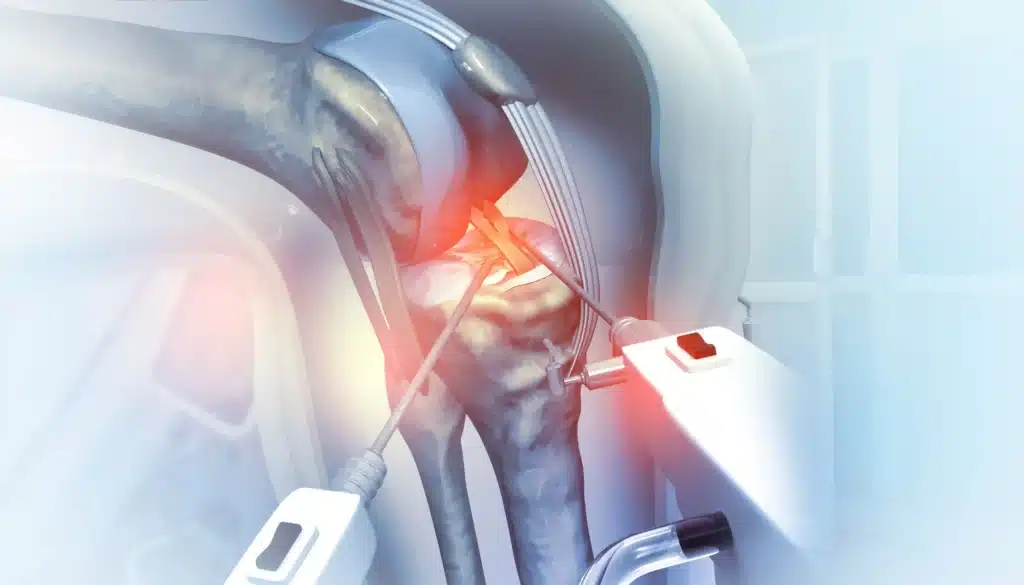
A partial knee replacement is a surgical procedure that replaces only the damaged part of the knee joint. Also known as unicompartmental knee surgery, it focuses on a specific area of the joint while preserving unaffected structures elsewhere in the knee.
Treating Only The Damaged Area
The knee is made up of three compartments:
- The medial (inner) compartment
- The lateral (outer) compartment
- The patellofemoral compartment behind the kneecap
Knee arthritis doesn’t always affect all three compartments equally. Some patients develop damage predominantly within one compartment while the other parts of the knee remain relatively healthy.
When this occurs, your surgeon may consider a partial knee replacement. Rather than resurfacing the entire knee, the procedure targets only the compartment affected by arthritis and cartilage loss.
Preserving Ligaments And Healthy Bone
Because only one portion of the knee is treated, a partial knee replacement preserves more of the joint’s native ligaments.
This may include retaining healthy bone and important stabilising ligaments when they remain intact. By focusing on the damaged compartment, the procedure avoids replacing parts of the knee that may still be functioning normally.
However, preserving these structures is only possible when the surrounding joint remains in suitable condition.
Who May Be Suitable For Partial Knee Replacement?
In addition to symptoms, surgeons assess factors such as the extent of joint damage, the condition of the surrounding structures, and whether the arthritis is confined to a specific compartment. The following characteristics may indicate that a patient is suitable for a partial knee replacement.
Early-To-Mid Knee Arthritis
Some patients with early-to-mid-stage knee arthritis continue to experience symptoms despite physiotherapy, medication, activity modification, or other forms of conservative treatment.
When these measures no longer provide sufficient relief, surgical treatment may be considered. For these patients, a partial knee replacement may be one of the available options following an orthopaedic assessment.
Bone-On-Bone In One Compartment
Some patients develop bone-on-bone arthritis after the cartilage in one compartment of the knee has worn away completely.
While this often sounds severe, bone-on-bone arthritis does not automatically mean the entire knee requires full replacement. Suitability depends on the overall condition of the joint and whether the remaining compartments continue to function well.
Knee Pain When Walking Or Climbing Stairs
Pain during weight-bearing activities can provide clues about how arthritis is affecting your knee.
For example, some patients experience discomfort primarily when loading a specific part of the joint, such as when climbing stairs, getting up from a chair, or walking on uneven ground. These patterns may help surgeons correlate symptoms with imaging findings and identify the compartment most affected by arthritis.
Although symptoms alone cannot determine whether a partial knee replacement is appropriate, they form an important part of the overall assessment.
Localised Cartilage Wear
The pattern of cartilage wear helps surgeons understand which parts of the knee remain functional.
For some patients, cartilage loss is concentrated in a specific area, while others have degeneration affecting larger portions of the joint. This information helps determine whether preserving part of the knee remains a realistic option.
If you’ve been told you need total knee replacement surgery and are worried about the long recovery period, it may be worth seeking a second opinion. Learn more about unicompartmental knee surgery and when it may be considered as a viable treatment option.
When Total Knee Replacement May Still Be Needed
While some patients may be suitable candidates for a partial knee replacement, others may still benefit more from a total knee replacement.
Arthritis In Multiple Compartments
When arthritis affects multiple compartments, symptoms often arise from several areas of the knee rather than a single source.
In these situations, addressing only one part of the joint may not adequately relieve symptoms. A total knee replacement may therefore be more appropriate because it addresses the knee as a whole.
Severe Bone And Joint Damage
As arthritis progresses, the damage may extend beyond cartilage loss alone.
Some patients develop substantial changes to the underlying bone and joint surfaces, making it more difficult to preserve unaffected structures within the knee. When the overall condition of the joint has deteriorated significantly, a total knee replacement would be recommended rather than a compartment-specific procedure.
Knee Instability Or Deformity
The success of a partial knee replacement depends partly on the stability and alignment of the knee.
Significant ligament insufficiency, marked instability, or pronounced deformities may affect how the joint functions and distributes weight. In these circumstances, a total knee replacement provides a more suitable solution by addressing the knee as a whole.
Widespread Arthritis In The Knee
In some patients, arthritis gradually progresses throughout the joint over time.
Rather than being concentrated in one area, the degeneration affects multiple parts of the knee and contributes to persistent pain, stiffness, and reduced mobility. When arthritis becomes widespread, a total knee replacement is often better suited to address the full extent of joint damage.
Explore Knee Replacement Options at Alps Orthopaedic Centre
If knee pain is affecting your daily activities, it may be time to explore your treatment options. At Alps Orthopaedic Centre, we can assess your condition and determine whether a partial or total knee replacement may be appropriate. Our goal is to help you regain mobility and return to an active lifestyle as soon as possible.
Book a same day appointment with us today.
FAQs About Partial Knee Replacement
How long does partial knee replacement last?
A partial knee replacement can last many years. Longevity depends on factors such as age, activity level, implant type, and whether arthritis develops in other parts of the knee over time.
Is unicompartmental knee surgery less painful?
Unicompartmental knee surgery may be associated with less postoperative discomfort than a total knee replacement. However, recovery experiences vary, and the amount of pain depends on individual factors and rehabilitation progress.
Can arthritis come back after partial knee replacement?
Arthritis does not return in the compartment that has been replaced. However, arthritis may continue to develop in other parts of the knee that were not affected at the time of surgery.
Who is not suitable for partial knee replacement?
Patients with arthritis affecting multiple compartments of the knee may not be suitable for a partial knee replacement. Significant knee instability, severe deformity, or extensive joint damage may also make a total knee replacement more appropriate.
